
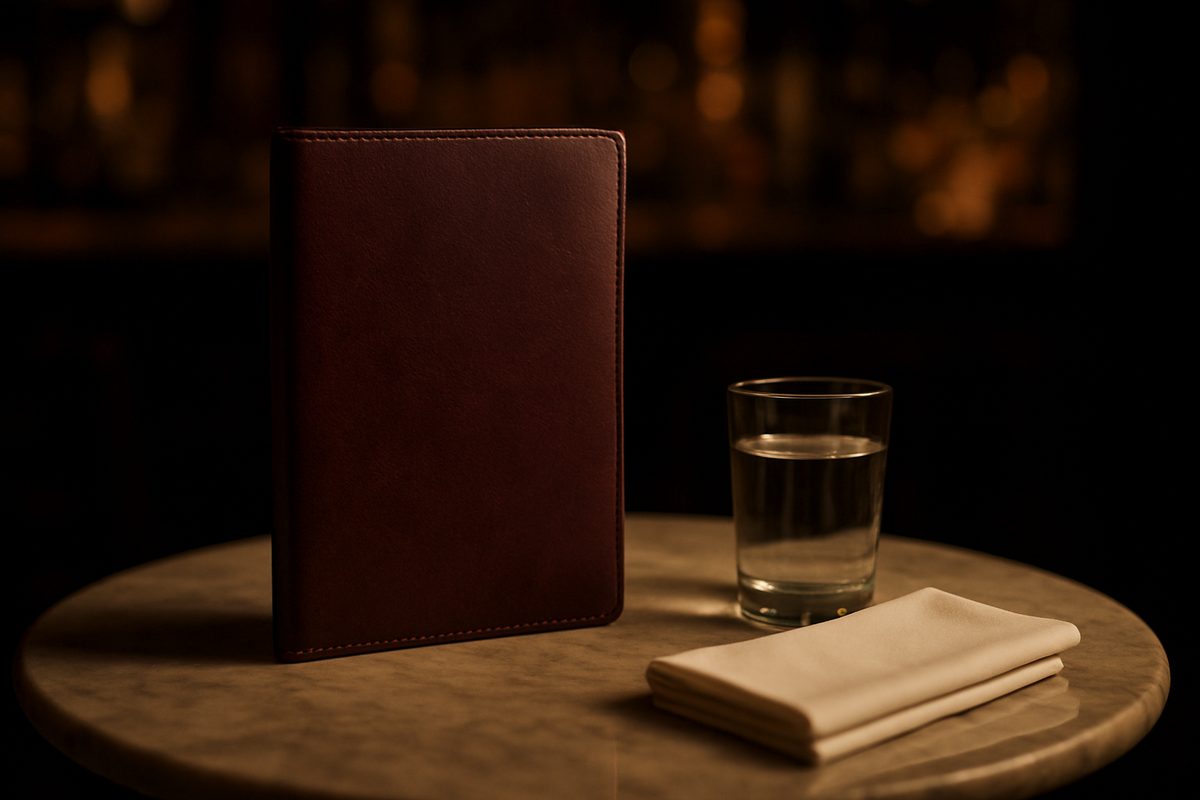
In a small restaurant or bar, a menu cover is not just a piece of presentation. It gets handled dozens of times a shift, wiped down between parties, stacked in a narrow host stand, and occasionally dropped onto a wet floor. The tighter the room, the more the cover has to earn its place on the table. That changes the way owners and managers should evaluate options. A cover that looks good in a catalog can become a daily annoyance if it is too thick, too slippery, too hard to clean, or too large for a two-top along a banquette.
Start With the Cover’s Working Job
Before looking at materials, separate the cover’s real jobs from its visual job. The visual job is to look clean and match the room. The working job is to protect the printed pages, stay stable on a small table, and survive quick cleaning. In a dense urban district, those working demands are usually more important than a textured finish or a heavy brass corner.
A cover has to open flat without sliding. It has to stay closed when stacked. It has to be easy to grab from a server station. It has to tolerate being wiped with sanitizer, water, or a damp rag. If it fails at any of those tasks, the front-of-house team will find workarounds that often look worse than the worn cover itself.
Small rooms also put the cover in closer contact with food and elbows. On a narrow table, a menu may sit beside a water glass, a candle, and a bread plate. The cover should not shed fibers, absorb oil, or transfer dye when wet. These are practical failures that guests notice before they notice the logo.

Materials That Survive Heavy Footfall
Material choice drives most of the buying decision. For small rooms, the material has to balance weight, cleanability, and thickness. The main options are laminated paperboard, flexible synthetic covers, leatherette or bonded leather, and wood or wood-effect boards.
Laminated paperboard is the most replaceable option. It is light, thin, and easy to print in short runs. It works well for menus that change often or for a bar that runs weekly specials. The weakness is the edge. In a high-volume room, laminated edges can split after repeated wiping and stacking. Once water gets into the board, the cover warps and the pages inside start to look tired.
Flexible synthetic covers, usually made from polypropylene or PVC, are a step up in durability. They are wipe-clean, resistant to most spills, and thin enough to fit in a server apron. The trade-off is feel. Some synthetic covers look and feel like office supplies. That may not matter in a fast-casual room, but it can feel cheap in a full-service dining room. Corners can also curl over time, especially when covers are stored upright in a tight rack.
Leatherette and bonded leather covers are common in smaller full-service restaurants. They offer a warmer look, hide fingerprints reasonably well, and hold up under regular wiping. The extra thickness is the main concern. If every table is small, a thick padded cover can crowd the setting. A better choice for a small room is usually a slim leatherette cover with minimal padding and stitched edges, rather than a heavy padded binder.
Wood and wood-effect covers are the most rigid option. They protect pages well and can look distinctive in a narrow space. The weight and thickness make them less practical for high stack counts. They also show scratches and water rings more than darker synthetic materials. Reserve these for a permanent menu that does not change often and for rooms where the cover is part of the table setting rather than a hand-off item.
A Quick Material Comparison
- Laminated paperboard: low cost, thin, replaceable, but weak at the edges.
- Flexible synthetic: wipe-clean and light, but can curl and feel utilitarian.
- Leatherette: durable and warm, but choose a slim build for small tables.
- Wood effect: strong and distinctive, but heavy and prone to visible wear.
Formats That Fit Without Owning the Table
Format is where small rooms save the most trouble. A cover that is too wide will hang over the edge of a small table. A cover that is too tall will be impossible to open without moving glasses. A cover that opens into three panels may work at a large booth but becomes a puzzle on a narrow two-top along a wall.
The most useful formats for small rooms are single-panel and two-panel covers. A single-panel cover holds one or two sheets and can be handed to a guest like a clipboard, which works well at a bar counter. A two-panel cover opens once and lies mostly flat. It gives enough space for a compact menu without asking the guest to unfold a map.
Consider the page size before the cover size. A smaller page format can allow a larger typeface by forcing the menu to be shorter. Many small rooms benefit from a narrow page that fits a two-panel cover with a low profile. Avoid covers with wide spines or metal rings. Rings catch on napkins, scratch wood tables, and add thickness at the fold.
Bar Counters and Ledge Seating
At a bar or ledge, the cover often has to stand upright against a back bar or be passed directly from a bartender. A rigid cover with a rough back can slide less on a polished surface. A heavy cover can be easier to set down in a narrow gap, but it is harder to store in quantity. For bar use, many operators choose a thin synthetic or laminated cover that can be wiped quickly and replaced without much thought.

Cleaning, Stacking and Replacement
In a small room, cleaning a menu cover is rarely a separate task. It happens between seatings, during side work, and whenever a server notices a smear. That means the cover has to be compatible with the sanitizer the team already uses. Some materials degrade with repeated exposure to quaternary sanitizer or bleach solutions. If a cover’s finish turns sticky or starts to peel, it is no longer a small problem.
Stacking matters more in a small room than in a large one. The host stand may have one narrow drawer. The server station may be a single shelf. Covers that do not stack flat create a pile that tips over. Covers with metal corners or raised emblems can scratch the cover below them. Look for covers with rounded corners and a smooth back, and test how a stack of ten sits on a shelf before committing to a large order.
Replacement is part of the plan. A small room cannot hide a worn cover because there are only a few on the floor at any time. That actually works in your favor. You can rotate covers through cleaning and replace them in smaller batches. The best approach is to treat covers as a consumable line item, not a one-time purchase. Choose a supplier or style that can be reordered without a long wait.
When to Replace a Cover
- The edges have split or the board is exposed.
- The surface stays greasy after wiping.
- The cover no longer lies flat or closes fully.
- The color has worn through to a different layer.
- The pages inside slip out during service.
How to Choose Without Overbuying
The right restaurant menus cover should be tested under the same conditions as a busy shift. Start with a small sample order. Put the samples on a real table with water glasses, plates, and silverware. Have a server wipe them with the standard sanitizer. Drop one on the floor. Stack several in the actual storage space. The cover that survives those tests is the one that belongs in the room.
Do not overbuy features that add cost without adding function. Embossing, foil stamping, and heavy hardware can look sharp in a sample, but they often create cleaning and stacking problems in a small room. The most practical upgrade is usually a better edge, not a heavier cover. Sewn edges on leatherette, sealed edges on synthetic covers, and reinforced corners on laminated covers all extend life more than decoration.
If the menu changes daily or weekly, keep the cover simple and the page replacement easy. A cover with a clear internal pocket or a simple spine can be updated without reordering the whole piece. If the menu is permanent, you can spend more on the cover itself because the pages will not change.
Common Mistakes That Show Up Quickly
The most common mistake in a small room is choosing a cover that is too large. It looks fine on a sample board but overwhelms a 24-inch table once water glasses and silverware are set. A cover should be smaller than the table setting, not equal to it.
Another mistake is matching the dining room decor before matching the cleaning process. A raw wood cover may look right in a rustic room, but it will stain and swell when it meets sanitizer. A white cover hides less than many owners expect. Dark covers show dust and water spots, while pale covers show wine and coffee. A mid-tone or textured surface often hides the widest range of daily damage.
Skipping a sample test is the most avoidable error. A cover can feel sturdy in a box and fail on day one in a busy restaurant. Ordering one sample and leaving it at the host stand for a week will reveal more than any catalog description.
A Working Checklist for Small-Room Menu Covers
Use this checklist when comparing samples. A cover that fails any one of these points will create more work in a tight room.
- Opens flat on a small table without sliding.
- Wipes clean with the sanitizer already in use.
- Stacks flat without scratching the cover below.
- Fits in the host stand or server shelf without forcing.
- Has rounded corners or sealed edges that resist peeling.
- Feels appropriate to the room without looking like office equipment.
- Reorders easily in small batches when covers begin to fail.
- Protects the pages without adding unnecessary height or width.
A small room rewards restraint. The fewer covers you need, the more each one has to work. The best choice is usually the simplest cover that can be wiped quickly, stacked tightly, and replaced without drama.